|
Bombing Incidents in Ireland during the Emergency 1939 - 1945. |
The nature of total war as was found during the Second World War that any country trying to stay neutral was going to suffer some consequences of that conflict going on around its borders. And it was because of this that Dublin and other places in Ireland suffered damage and loss of life during 1940 and 1941. The incidents were thankfully few in numbers and caused minimum loss of life. They are however stark reminders to us how close Ireland was to the greatest conflict in history. They are also shrouded in myth and conjecture, and for this reason, I hope the following article will shine some light on some of this subject. The following is only a presentation of available sources and not an indept effort at research by any means. Updated March 22nd 2009
Two of the earliest incidents occurred on Tuesday, August 26th 1940, in County Wexford. In one of these, bombs fell near the Railway viaduct bridge at Ambrosetown and the home of Mr. Jim Hawkins, in Duncormick, about 5 miles from Campile Creamery. Some damage was caused to the roof of the house but no one was injured1. Shortly after, a device was dropped on the creamery at Campile. Tragically, 3 young women lost their lives. The dead girls were Mary Ellen Kent (35), who was in charge of the restaurant attached to the premises, and her sister, Catherine Kent (25), an assistant in the drapery portion of the premises, both of Terreragh; and Kathleen Hurley (25), an assistant in the restaurant, from Garryduff. In the immediate aftermath the Irish government withheld identifying the nationality of the aircraft until such information could be confirmed. Subseqently German radio annonced that one of their aricraft was responsibe. A check on Irish Newspapers from that week and after show that the story was widely covered and refered to German aircraft having dropped the weapon. As at this time, Germany was in the ascendancy, the Irish government was immediate but low key in their protests, so as not to antagonize the then seemingly unstoppable Germans. (2) That same night, London suffered 6 hours of bombing by Luftwaffe forces. (3) In March of 1943, the German, government paid out £9000 in reparation. Strangely, as late as July 2006, an article in a national newspaper called for a Government tribunal into the bombing to determine the reason for the event.4
Here is website prepared by the students of local Scoil Mhuire, Horeswood National School on the Incident - Campile Bombing
1E-mail correspondence with Mr. Michael Martin,
Tullycanna, Wexford - 2002
2O'Drisceoil, Donal "Censorship in Ireland 1939 - 1945"
(Cork University Press -1996) Pg. 106
3Images of War (Periodical) Orbis Publishing 1996-1998
War Diary Part 1 - Pg. 6
4Noel Whelan, 'A modest proposal to solve Campile
mystery', July 22 2006, Irish Times
Patrick J Cummins, "Emergency" Air Accidents - South-East Ireland
1940 - 1945, 2003
Irish National Archives, Dept. of the Taioseach online file index
search.
The next events occurred on Friday, December 20, 1940. The first
began after 7 PM when residents of Dun Laoghaire, in south Dublin,
claimed to have seen flares in the sky followed promptly by bombs
falling and exploding. More fell moments later near Sandycove
Railway station. Three people were injured during this. Not much
later, two bombs fell on Shantouagh town-land, near to
Carrickmacross, Co. Monaghan. This is also said to be Bock Upper
town land. December 20th and 21st had seen Liverpool
targeted by the Luftwaffe and it may have been aircraft from these
raids, which would have flown up over the Irish Sea, that became
lost and then dropped their bomb-loads over Ireland.(3)
Throughout the 1940 - 1941 period, it appears that Irish Army
Authorities frequently plotted aircraft flying deep within Irish
airspace. Protests over these flights were made to the Belligerent
countries by Irish officials.
The next series of incidents occurred over the first three nights
of New Year 1941. (5) On the 1st of January, 8 bombs
fell on Duleek and Julianstown, Co. Meath. There were no injuries
from either of these incidents.
That morning, after 6am, 2nd January, 2 bombs destroyed several
houses in Terenure, in south Dublin. Again, there were no
fatalities but 7 people were injured. Three more bombs falling on
Ballymurrin, County Wexford caused no damage or injuries. Again
that same night, 2 bombs fell on waste ground in Fortfield Road,
Dublin, caused no more injuries but some damage to property. High
Explosive (HE) and incendiary bombs fell on the Curragh Racecourse
outside of Dublin and more weapons fell in County Wicklow. This
night ended sadly however with the death of 3 family members in a
house in Knockroe, near Borris in County Carlow. Sisters, Mary
Ellen (40) and Bridget (38) Shannon, along with their niece
Kathleen Shannon (16) lost their lives when one of a stick of
eight bombs destroyed part of the house in Knockroe. Mary
Ellen and Bridget's brother Michael was also injured and while he
was released from hospital on 28 February 1941, he died three
years later in Kilkenny Hospital. All four are buried
together in Rathanna graveyard.
The incidents continued in the early hours of 3 January, when 20
people were injured and two houses destroyed in the in the Donore
Terrace area on the South Circular Road.
This archive
content report from Dublin City Archives has a small
narrative which explains the incident somewhat and lists their
holdings on the issue.
It was following this series of events that suspicion arose in
some circles that the bombings might have been deliberate action
by one or more of the belligerents in an attempt to draw Ireland
into the war. They occurred after a curious incident prior to the
New Year when the German Legation requested that extra staff be
allowed to join them by flying into Rinneanna. The Irish
government refused and the question was put to rest. Others
believed that they were captured German weapons dropped from
British aircraft again in an attempt to force Ireland into the
war. This idea was fueled in preceding weeks by German propaganda
radio broadcasts, which suggested that the British might try
something such as this.
John P Duggan is his book neutral Ireland and the Third Reich makes mention of weapons dropped in 'Malin' in Donegal. There is an archives reference but I'm unable to determine what this refers to. During a visit to the Inishowen in April 2007 a local man who served in the LDF at the time did point out in passing a location near Glengad head where bombs had been dropped in a field. An event that I must do a bit of searching on.
The most infamous incident occurred on the early morning of
Saturday, May 31st. The people of Dublin were preparing for the
bank holiday weekend. Just after 12pm, Army search lights went
into operation. There had been many reports that night of
aircraft over-flying the eastern seaboard as well as reports of
explosions out to sea, a sign of crews abandoning their
bomb-loads. About half an hour later, guns of the Anti-aircraft
battalion opening fired on aircraft above the city, as was
normal standing practice with unidentified aircraft 'presenting
a reasonable target'.
At 1.30 am, the first bombs dropped on North Richmond Street and
Rutland Place.
Another bomb fell near the Dog (or Citadel) pond pumping station
in the Phoenix Park near the cricket grounds. This bomb damaged
some of the Dublin Zoo buildings but caused no injuries among
staff or animals there. Also damaged by this bomb, were the
windows of Aras an Uactarain, the residence of the Irish
President Douglas Hyde. The Irish Press published a
caption on a photo that reported that the family of a Joseph
McNally had escaped injury when their home at the pumping
station collapsed.
Next, at 2.05am the most horrific of all events happened. What
turned out to be a German 'Land Mine' landed on the North Strand
Road between the 'Five Lamps' and Newcommen Bridge. As was
experienced by hundreds in London, and more recently in Belfast,
this weapon ripped apart this part of the city and left the area
in ruins. As the stunned Emergency services set about their
onerous task of searching for survivors, LDF and LSF forces
cordoned off the area. Mobile Units of St. Johns Ambulance
hurried to the scene and provided significant help. First aid
was administered and the more seriously injured transferred to
local hospitals such as the Mater. Civil Defence services were
also heavily involved including the Auxiliary Fire Service,
Rescue service and Casualty Service. In the aftermath of the
incident the death toll stood at 29*, with
90 injured and 300 houses destroyed or damaged. Almost 400
people were left permanently or temporarily homeless.
The names of those killed as dertermined by a review of the
national newspapers May 31st to June 6th 1941 and from
headstones where found. Dublin City Council Provide access to
the 1939 - 1940 Electoral register at the following link which
allows for better cross checking of the names.
| - | Name | Age (Est) | Relation | Resident at | Buried, Date | Headstone Inscription | 1939-1940 Electoral register |
|---|---|---|---|---|---|---|---|
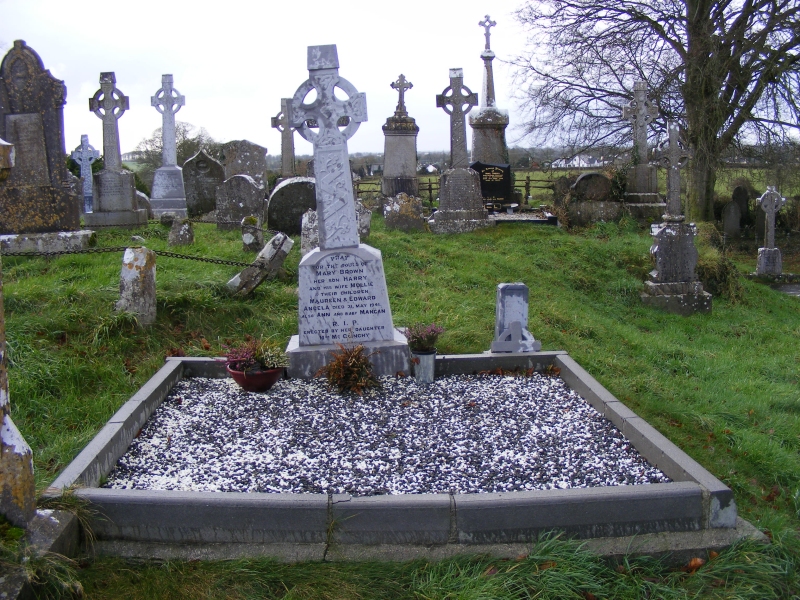
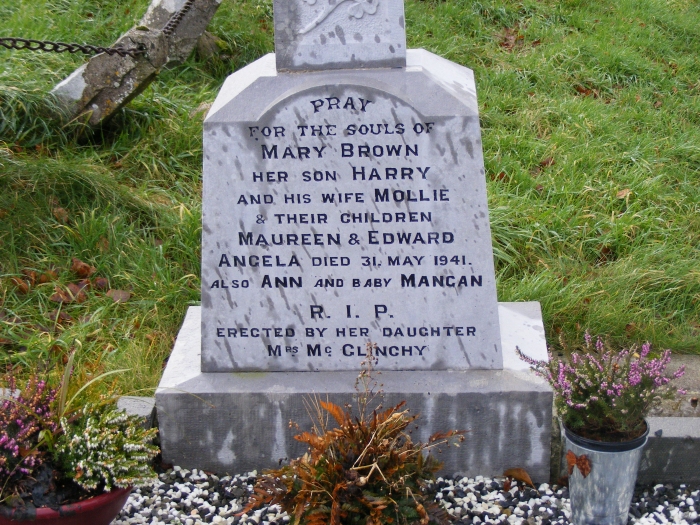
| 1 | Mary Browne | 75 | Mother of Harry Browne | 24 North Strand Road | Edenderry June 4th |
Mary Brown her son Harry and his wife Mollie & their children Maureen and Edward Angela died 31 May 1941 also Ann and Baby Mangan R.I.P. erected by her daughter Mrs. McGlinchy |
I've assumed that she is not listed and that her daughter in law is. |
| 2 | Harry Browne, papers name him Henry | - | Son of; | 24 North Strand Road | Edenderry June 4th | No. 25 Harry Brown | |
| 3 | Mary Browne (Nee Corrigan) | 33 | Wife of; | 24 North Strand Road | Edenderry June 4th | No. 25 Mary Brown | |
| 4 | Maureen Browne | 7 | Daughter of; | 24 North Strand Road | Edenderry June 4th | N/A Under 21 | |
| 5 | Ann Browne | 5 | Sister of; | 24 North Strand Road | Edenderry June 4th | N/A Under 21 | |
| 6 | Edward Browne | 3.5 | Brother of; | 24 North Strand Road | Edenderry June 4th | N/A Under 21 | |
| 7 | Angela Browne | 2 | Sister of; | 24 North Strand Road | Edenderry June 4th | N/A Under 21 | |
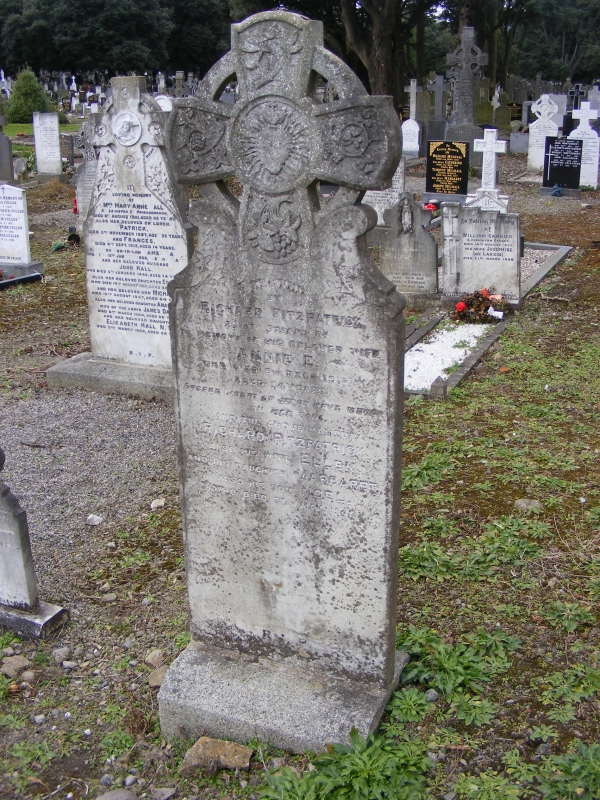
| 8 | Richard Fitzpatrick | 60 | Husband Of Ellen | 28 North Strand Road | Glasnevin, June 4th | The Fitzpatrick Family headstone reads:
28 Nth Strand Road In memory of his beloved wife Annie E Who died 9th December 1913 Aged 34 years Sacred heart of Jesus have mercy on her soul and the above named Richard Fitzpatrick Also his Wife Ellen and his daughter Margerate and his son Noel who died 31st May 1941 |
No. 28 Richard Fitzpatrick, he and his family can be found living at this address in the 1911 Census where Richard Senior is listed as being a Victualler. |
| 9 | Ellen Fitzpatrick | 55 | Wife of Richard | 28 North Strand Road | Glasnevin, June 4th | No. 28 Ellen Fitzpatrick | |
| 10 | Margerate Fitzpatrick, also named Madge in newspapers | 36 | Daughter of Richard | 28 North Strand Road | Glasnevin, June 4th | No. 28 Margerate Fitzpatrick | |
| 11 | Noel Fitzpatrick | 32 | Son of Richard | 28 North Strand Road | Glasnevin, June 4th | No. 28 Noel Fitzpatrick | |
| 12 | John Murray | 54 | - | 154 North Strand Road | Glasnevin, June 4th | There is no headstone on this grave only a stone or concrete cross. Glasnevin records show that this plot also holds his wife, Kathleen, died 1918 and two young children. An infant daughter died 1910 and a male child died 1915. | No. 154 John Murray |
| 13 | Mrs. Marion Holton | 60 | - | 156 North Strand Road (162 ?) | Glasnevin, June 4th | There is no headstone for Mary A Holton on this grave but there is for her husband James J, who died in 1932. | Not listed at this address |
| 14 | Charles Sweeney | 61 | - | 11 North Strand Road | Dean's Grange, 4th June | Not visited. Buried in Plot, West/B1/9 | No. 11 Charles Sweeney |
| 15 | Mrs. Mary (Ellen) Boyle | - | - | 157 North Strand Road | Dean's Grange, 4th June | Not visited. Buried in St Ita, S, 28 plot. Listed as the wife of Patrick Boyle in the cemetery register. | Not listed for this address |
| 16 | Mr John Foran | - | - | 155 North Strand Road | Public Funeral 5th June |
Sheila Keelan Died 21st November 1972 her parents John and Mary Foran died 31st May 1941 her son Joseph Died 22nd Oct 1983 her husband Richard Died 2nd November 1986 R.I.P. |
No. 155 John Foran |
| 17 | Mrs Mary Foran | - | - | 155 North Strand Road | Public Funeral 5th June | No. 155 Mary Foran, also a Mary Foran (Jun) | |
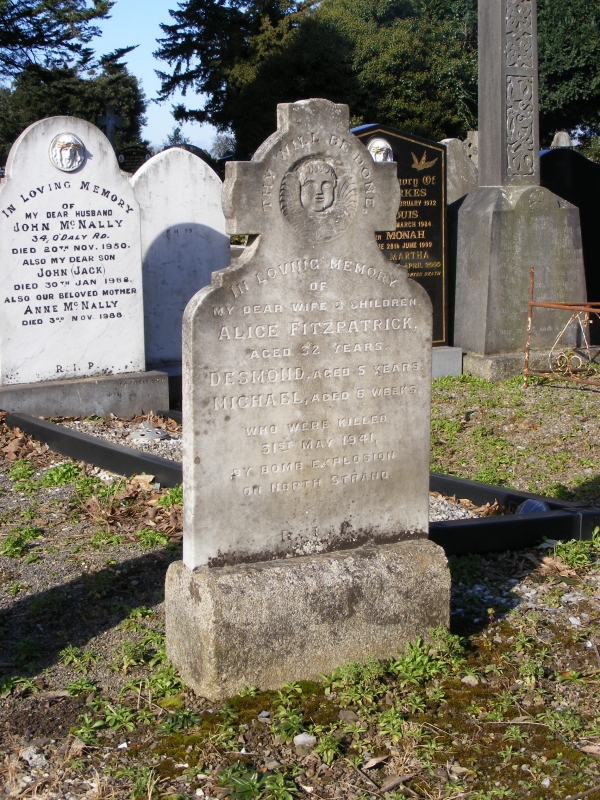
| 18 | Alice Fitzpatrick | 32 | Mother of Micheal and Desmond | 156 North Strand Road | Public Funeral 5th June |
MY DEAR WIFE & CHILDREN ALICE FITZPATRICK AGED 32 YEARS DESMOND, AGED 5 YEARS MICHAEL, AGED 6 WEEKS WHO WERE KILLED BY BOMB EXPLOSION ON NORTH STRAND. |
No. 156 Alice Fitzpatrick, also John Fitzpatrick |
| 19 | Micheal Fitzpatrick | 2 months | Son of Alice | 156 North Strand Road | Public Funeral 5th June | N/A Under 21 | |
| 20 | Desmond Fitzpatrick | 5 yrs | Son of Alice | 156 North Strand Road | Public Funeral 5th June | N/A Under 21 | |
| 21 | Mrs Josephine Fagan | 33 | Daughter of T Carroll | 157 North Strand Road | Public Funeral 5th June | The is no marker on the plot in which Josephine and Thomas are buried. Records show an Arthur Fagan was buried in that plot in 1966 also. | Not at this address |
| 22 | Thomas Carroll | 60 | Father of J Fagan | 157 North Strand Road | Public Funeral 5th June | No. 50 Thomas Carroll ? | |
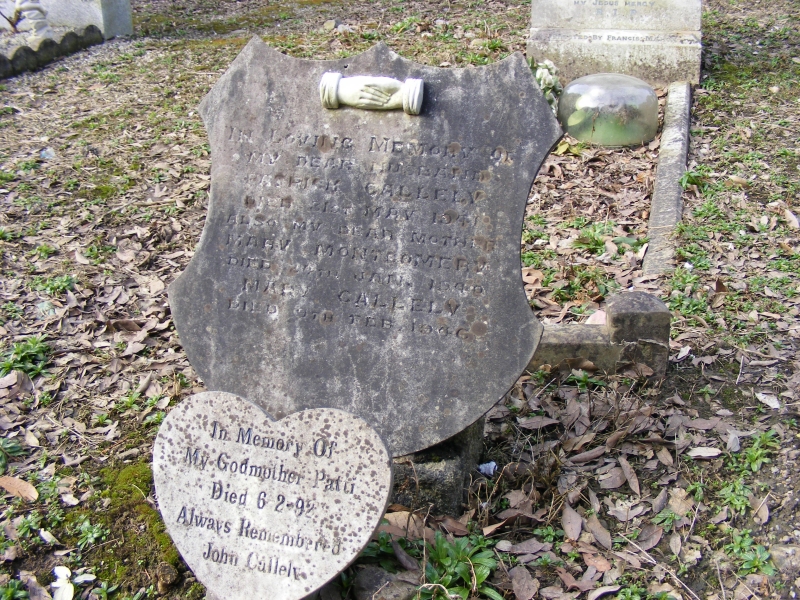
| 23 | Patrick Callely | - | - | 162 North Strand Road | Public Funeral 5th June |
My Dear Husband Patrick Callely Died 31st May 1941. Also my dear Mother Mary Montgomery Died 24th Jan 1940 Mary Callely Died 9th Feb 1946. |
No. 162 Patrick Callely, also Mary Callely |
| 24 | Elizabeth Daly | 50 | - | 162 North Strand Road | Public Funeral 5th June | Her plot has no headstone. | Perhaps No. 49 ? |
| 25 | Annie Malone | 79 | Died on the 14 June, coroners report includes her in the dead for the bombing. | 43 Summerhill Parade | Buried in Glasnevin |
Not yet visited plot, buried in Glasnevin, St
Bridgets, NH/196 plot. |
- |
| 26 | William McLoughlin | 2 | Son of Patrick McLoughlin, below. Died when the house the family had escaped to was damaged by the third bomb. | 41 Summerhill Road, Died at 157 NSR | Public Funeral 5th June | His plot has no headstone. | N/A Under 21 |
| 27 | Patrick McLoughlin | - | Father of William | 41 Summerhill Road at 157 NSR | P. McLoughlins remains were not found up to June 9. | Newspaper reports from August 1941 mention that the coroners report assumed that remains found were those of P. McLoughlan. | Not at this address |
| 28 | Lily Behan | 21 | - | 72 Shelmalier Road, East Wall | Died of injuries 22 August 1941 | To be determined | N/A Under 21, but Christina and Thomas Behan listed. |
| [29] | Newspapers on June 5 mentioned two unknown people from 162 NCR but clearly are in error as no mention is made in the coroners report. | - | - | 162 North Strand Road | Public Funeral 5th June | To be determined | - |
"Members of the Dáil desire to be directly associated with the expression of sympathy already tendered by the Government on behalf of the nation to the great number of [1584] our citizens who have been so cruelly bereaved by the recent bombing. Although a complete survey has not yet been possible, the latest report which I have received is that 27 persons were killed outright or subsequently died; 45 were wounded or received other serious bodily injury and are still in hospital; 25 houses were completely destroyed and 300 so damaged as to be unfit for habitation, leaving many hundreds of our people homeless. It has been for all our citizens an occasion of profound sorrow in which the members of this House have fully shared. (Members rose in their places.) The Dáil will also desire to be associated with the expression of sincere thanks which has gone out from the Government and from our whole community to the several voluntary organisations the devoted exertions of whose members helped to confine the extent of the disaster and have mitigated the sufferings of those affected by it. As I have already informed the public, a protest has been made to the German Government. The Dáil will not expect me, at the moment, to say more on this head." - Dáil Éireann Volume 83 05 June, 1941
  |
 |
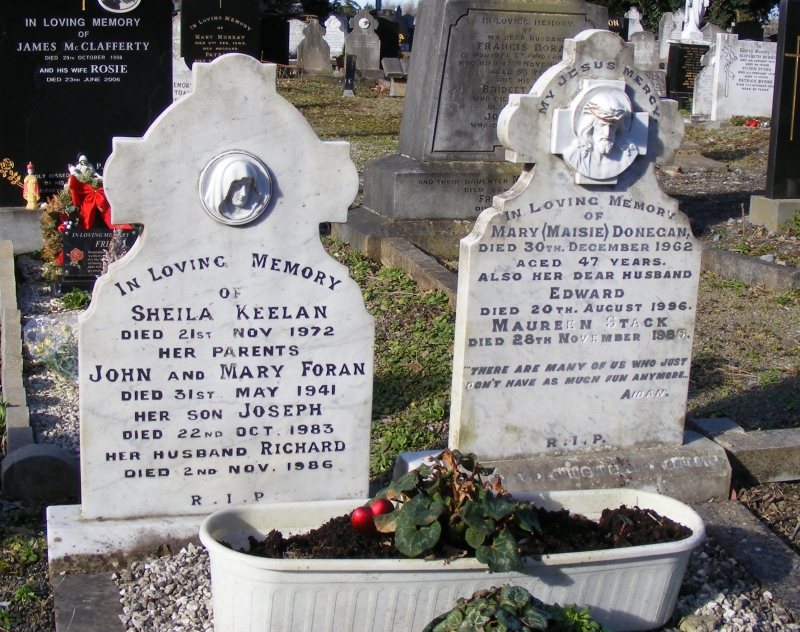 |
| The grave of the Brown Family, taken January 2009. The Brown family now rest in the peaceful cemetery at Drumcooley, outside of Edenderry town. The simple inscription belies the tragic events that took their lives. For the casual observer it is clear that something terrible occurred on that date to take the lives of so many from one family. | The Grave of Richard Fitzpatrick and family in Glasnevin Cemetery. | The grave of Mr. and Mrs. Foran in Glasnevin Cemetery. |
 |
 |
- |
| The grave of Alice Fitzpatrick and her children in Glasnevin Cemetery. This is the only headstone to mention the bombings. | The grave of P. Callely in Glasnevin Cemetery. | - |
Those people made homeless or otherwise effected by the bombing were to be looked after by Government aid and also by the generosity of other people.
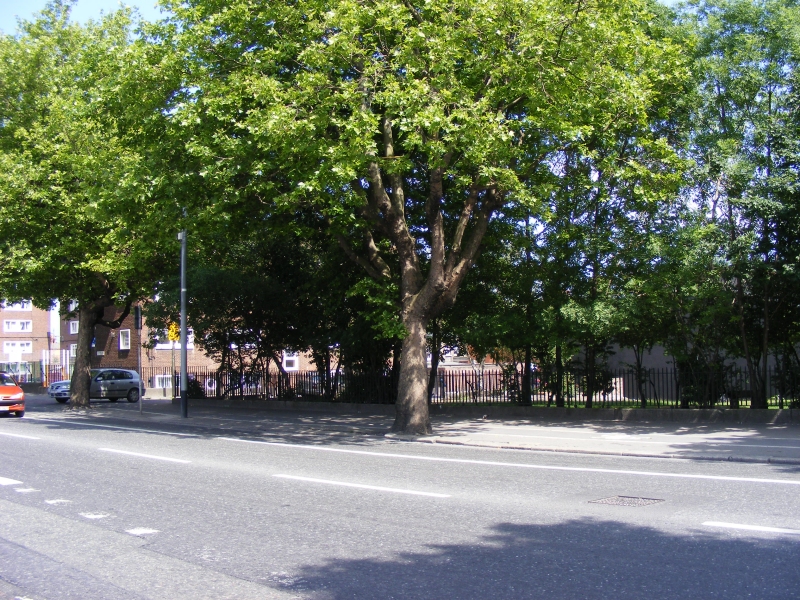
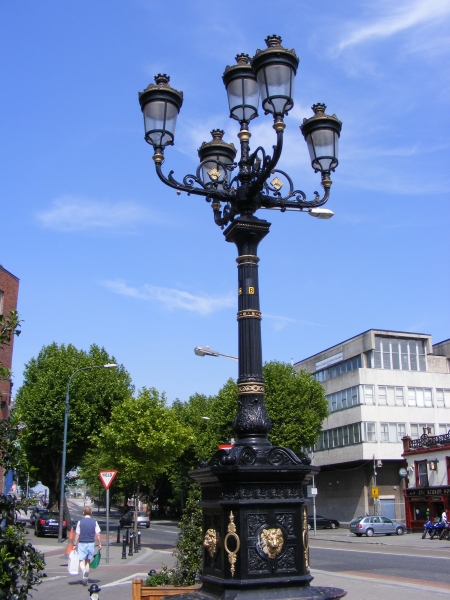
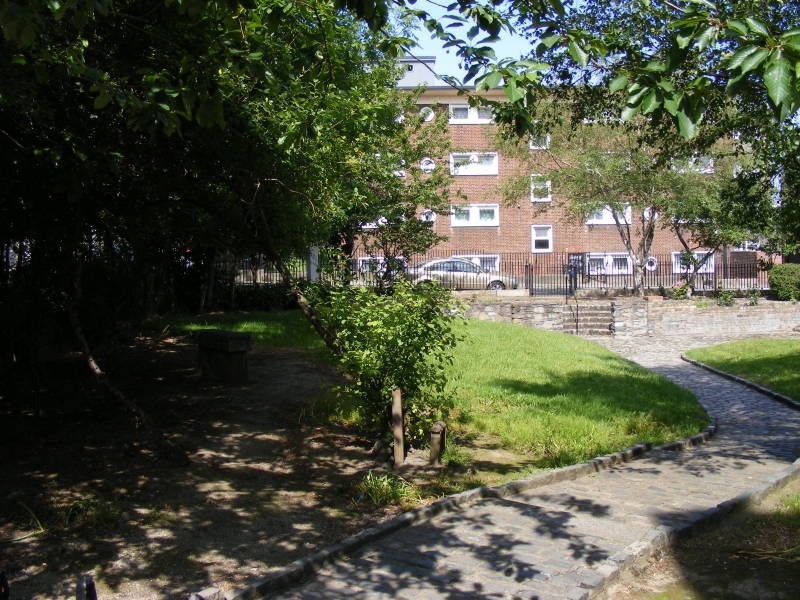
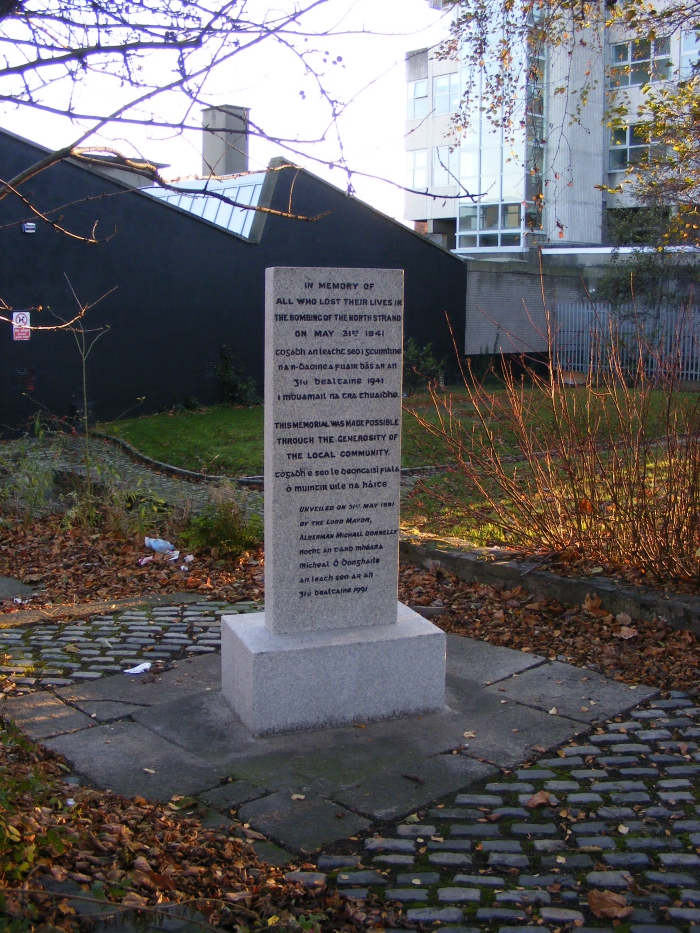
A plaque to commemorate the victims of the North Strand Bombing was unveiled at Charleville Mall Public Library on the 60th anniversary, 31 May 2001. Here are some pictures I took at the memorial garden in June 2007 and November 2008. Since I took my first pictures in 2007 the inscription text has been repainted and this is presented below.
 |
 |
 |
 |
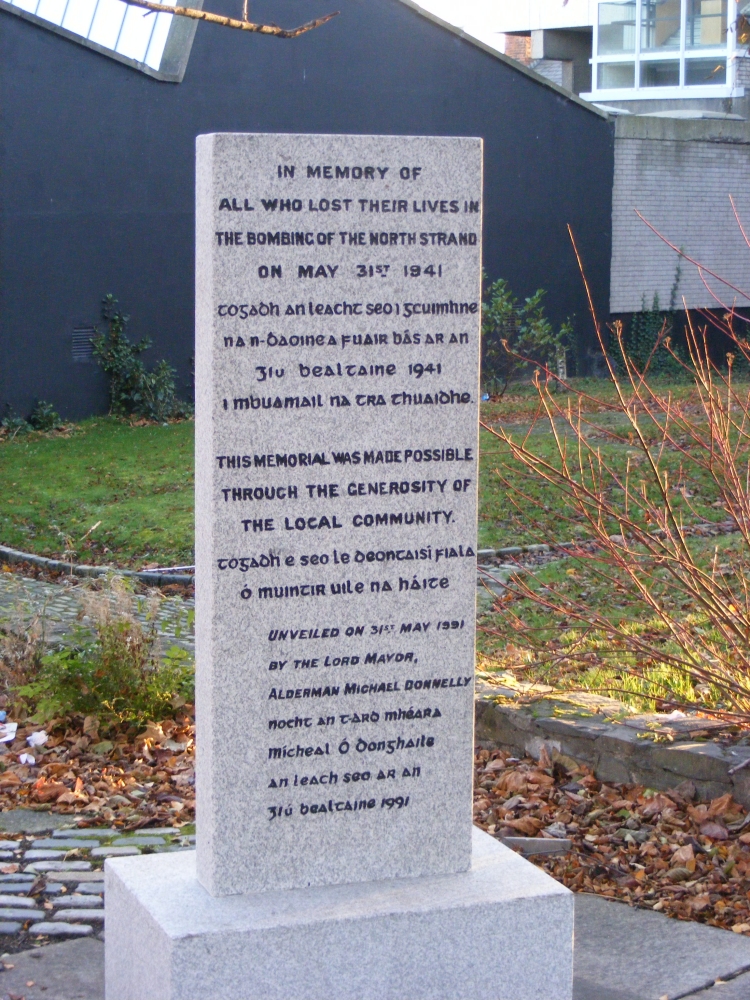 |
| The Memorial Garden on North Strand Road near Newcomen Bridge beside the VEC. June 2007 | The lamp post at the Five Lamps Corner. June 2007 | The inside of the Memorial Garden, June 2007 | The inscribed Memorial Stone inside the garden. November 2008 | The inscribed Memorial Stone inside the garden, a close up of the text. November 2008 |
|
IN MEMORY OF ALL WHO LOST THEIR LIVES IN THE BOMBING OF THE NORTH STRAND ON MAY 31ST 1941 THIS MEMORIAL WAS MADE POSSIBLE THROUGH THE GENEROSITY OF THE LOCAL COMMUNITY. UNVEILED ON 31ST MAY 1991 BY THE LORD MAYOR, ALDERMAN MICHAEL DONNELLY. |
||||
Newspapers in the UK and Ireland
reported on this incident, that last bombing of of Ireland
during the war. The newspapers of Monday, 2nd June
1941 reported that a bomb had fallen a quarter of a mile on
the north side of Arklow, Co. Wicklow early on the Sunday
morning. It had fallen on open ground causing no
casualties and either, depending on the notes published,
causing no property damage, or some property damage.
There appears to be little more mention of that however
after the 2nd June.
The Wicklow People published on
Saturday 7th June printed the following in the Arklow Notes
section.
ARKLOW NOTES
Bomb causes Damage at Arklow. - A bomb fell in
the Arklow area shortly after one o'clock on Sunday
morning. when houses to the number of thirty on Wexford
Road and Colgrearrey Road were damaged, but no person
was injured. The bomb tore big crater in a wheat field
at Lamberton, the property of Mr. David Lane. Inquiries
go to show that residents on Wexford Road, Coolgreaney
Road and Upper Main St., were awakened by the of the
falling bombs and also 'the noise of breaking glass.
Smoke was seen from apparently where the bomb had fallen
and appeared to be in the vicinity of the houses at
Wexford Road. Members of the L.D.F. and L.S.F. together
with civilians and Gardai immediately organised a search
party, and the crater was discovered in the field at
Lamberton, a distance of about 220 yards from the houses
at Parnell Terrace, at Wexford Road. The area was
immediately cordoned off to prevent approach to the
scone. Military arrived on the scene and removed an
unexploded bomb as well as the fragments of one which
had exploded. A further search revealed that another
bomb had been dropped on the Marsh beside the Avoca
river, arid also in close proximity to the town. Owing
to the wet nature of the ground in the latter case, the
bomb would seem to have penetrated to a considerable
distance, and it was not disturbed. The L.D.F. and
L.S.F. showed great promptitude and alert mobilisation.
Mr. R. Bradshaw. Group Leader with Asst. Groap Leader W.
Byrne and all the other Group Officers with more than
two-thirds of the men were mobilised within a few
minutes. Mr. M. Hickey and Mr. Liam Cleary,
Communications Officer. were also promptly on the scene.
The scene of the occurrence was visited by Chief Supt.
Quinn. Garda Siochana, Bray, and Supt. Flynn. Wicklow.
Repairs to Damaged Houses — It was decided at the
monthly meeting of the Arklow U.D.C. that the repairs
found necessary to the Council's houses, consequent upon
the damage caused through the explosion of tombs dropped
last Sunday morning. be carried out the Clerk to keep a
separate account for the purpose of compensation claims.
It is understood that most of the damage in this
connection consists of broken window panes and loose
roof tiles.
Lamberton is a townland to the east of
of the town center and at that time was still a rural area
and which contained a Country House, Lamberton House.
The townland is now largely covered in housing developments.
I was once put to task regarding the number of fatalities for the night of May 31st 1941. As one reads different books and articles, one can almost be forgiven for being confused. Below are various totals from various sources.
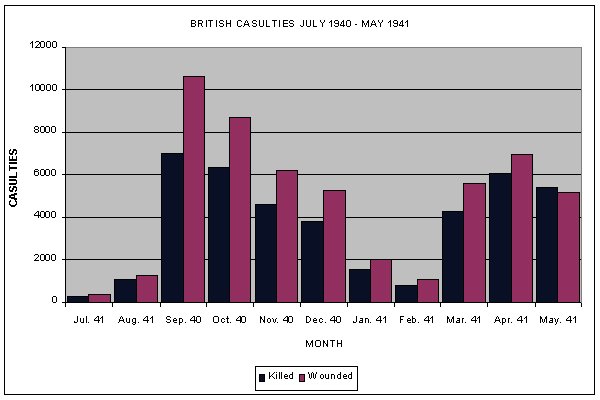
In the same period as the above attacks occurred, Great Britain
was under heavy air attack from the German Luftwaffe. As a means
of putting the Irish casualties into some context I here provide
some figures for casualties suffered in Britain from German
bomber attacks. As can be seen, during this period, the human
suffering in Britain was immense. In May 1941 alone, 5394 people
were killed. Six of the months shown returned casualties of over
4000. I present these figures for two reasons, firstly, to
preempt any claims that I am trying to over play Irish
casualties. While the quantity of Irish casualties is much
smaller, the losses were equally saddening in that the people
involved were not at war with those who carried out the raids,
accidental though they were. A second reason is to give perhaps
some indication of what might have happened in Dublin had a full
scale bombing raid been launched upon it. With the city as
poorly defended as Belfast, casualties would have most likely
been horrendous in the densely packed inner city areas, much
like that found in the North Strand.