
Handley Page Halifax EB134, Ryehill, Co. Galway, November 1943
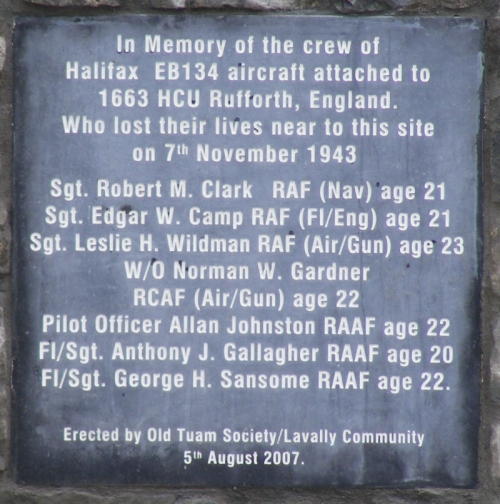 On the night of
November 7th/8th, 1943, the air war over over skies of Europe
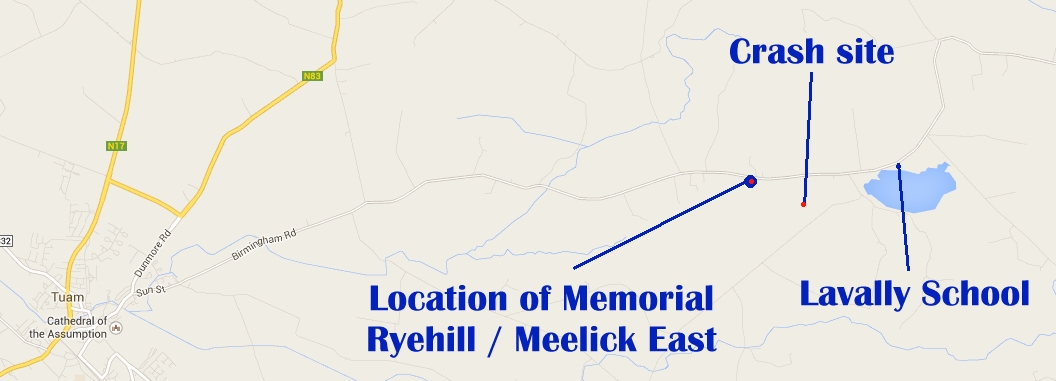
made a brief and devastating visit to the people of Lavally,
outside of Tuam in Galway. A large four engine Handley Page
Halifax bomber of the Royal Air Force crashed into farmland in
the Townland of Ryehill. The aircraft was completely destroyed
and its crew of seven killed.
On the night of
November 7th/8th, 1943, the air war over over skies of Europe
made a brief and devastating visit to the people of Lavally,
outside of Tuam in Galway. A large four engine Handley Page
Halifax bomber of the Royal Air Force crashed into farmland in
the Townland of Ryehill. The aircraft was completely destroyed
and its crew of seven killed.
The aircraft had been on a night training exercise with 1663
Heavy Conversion Unit (HCU) out of Rufforth in Yorkshire. The
crew were diverted to land at another airfield but for reasons
unknown, they became lost and their final landing was to be in
the low hills of Lavally outside of Tuam. There loss would be
just one of the frighteningly high losses suffered during
training missions. As many 8000 aircrew were lost on training
accidents.
The Irish Army report into the aftermath of the crash provides
some details of the scene after the accident. In a three
page memo from Major Timoney to Officer Commanding Western
Command, the following details were recorded.
Sir,
I have the honour to make the following report on the a/m
crash.
At 00.35 hours on the 8/11/43 the Orderly Officer in Renmore
Barracks received a phone message from the Tuam Gardai to
the effect that an aeroplane had crashed and was on fire at
CURRAGHCREEM, East of TUAM and that L.D.F. and Guards were
gone to the scene of the crash.
The Orderly Officer informed me immediately and the Stand-To
Party under Lieut. J. Coyle, with two Military Police, left
barracks at 01.00 hours for TUAM.
I proceeded there immediately, collecting Capt. Gaughan,
M.O. at his home and bringing Lieut. O'Toole, M.P.S. from
Barracks. We arrived on the scene of the crash about three
minutes after Lieut. Coyle.
Superintendent Walsh, Tuam and a few Guards were there and
about 15 to 20 people in Mufti, some of whom were L.D.F. I
withdrew everybody from the debris of the plane, and
instructed Lieut. Coyle to cordon off the area.
The Superintendent informed me that there were at least
three bodies, but owing to portions of the plane being
burning and
unexploded bombs in the field it was dangerous to move any
of the debris in the dark. I should mention that the night
was pitch dark and one could only move around with the aid
of a torch.
The Guards, Lieut. O'Toole, Capt. Gaughan and I searched the
ground the best we could looking for members of the crew who
might still be alive and in need of Medical attention. We
found bodies of four persons all of whom appeared to have
been killed instantly. There were several portions of the
plane still on fire which prevented our finding the
remaining bodies until day light. I saw two unexploded bombs
in the field and rang up Athlone for an Ordnance Officer to
deal with them.
I was later informed by Comdt. Doyle that they were smoke
bombs.
Immediately we got day-light the search continued and all
large pieces of the plane were removed to ensure that there
were no bodies underneath. We found three other bodies,
making a total of seven. Two of these bodies were obviously
killed instantly, and the third was badly burned. Portion of
the plane had to be cut away to release this body.
Capt.
Gaughan and I searched all the bodies for identification
purposes and collection of personal
belongings. Only two wore identity
discs. The remainder were identified by means of pay-books
and other personal documents found on the bodies. One man
had nothing on his person to indicate his identity, but
after cleaning the clay off his tunic we discovered the name
"SANSOME" on the breast of the tunic. We later found two
pocket-wallets containing personal documents bearing the
same name and £36. 18. 0 in notes and Orders as well as
other articles which were scattered over a large area.
Labels were tied to the bodies
according as they were identified and the relative personal
belongings put into separate envelopes.
The two identity discs were not removed in the Field as I
had intended removing the remains to Renmore to have the
bodies washed and cleaned before placing them in the
coffins. I intended removing the discs then. In the meantime
Capt. Birthistle arrived from Athlone and told me the usual
procedure was to have the bodies coffined as they were
found. He asked me to have the bodies brought to the Garda
Barracks, Tuam where he would have the coffins.
I handed over the bodies and the personal belongings to
Capt. Birthistle in Tuam Garda Barracks at 14.00 hours.
The memo continues
with details of the mens names and some of the meager
personnel possessions that were recovered from their
remains. It concludes then the observations of
It would appear that the plane
nose-dived into the ground and was hurled
forward as it exploded into thousands of pieces.
There is a mound, or an old Fort about 30 yards in front of,
and 30 ft. higher than the point which the craft
first hit the ground.
Parts of the Plane were found 50 yards beyond this Fort
and also all of the Crew were from 15 to 30 yards
beyond the fort except one man who was found between
the point of impact and the Fort.
The only arms were three .303 Browning Machine Guns
which seem to have escaped injury. Capt. O'Sullivan,
Baldonnel, took charge of the Machine Guns and all
the ammunition found which included some Verey
Lights. I had an exhaustive search carried out for small
arms but found none. There was no indication that
any of the crew carried small arms as we did not
find any clue, such as a belt, a holster or even a
round of revolver ammunition.
Capt. MacAndriu is in charge of a Guard and working
party of 20 O.Rs which is left while Capt.
O'Sullivan is removing the scrap. I am informed by
Capt. O'Sullivan that the site should be cleaned up
in seven or eight days.
Two days after the crash, the RAF filed a Form 765 report on
Flying accident or forced landing not attributable to enemy
action. It provides only basic details and indicated that
a fuller enquiry was to be carried out by No. 4 Group. The
basic details recorded were that, based on the time of crash
advised, the flight would have been 6 hours and 15 minutes
long. They were undertaking a cross country navigation
exercise and were heard faintly on radio at 22.03 and
22.34. They were given a QQM by Marston Moor after which
the W/T faded out. Nothing further was heard until word
came through that they had crashed in Ireland at 23.59.
There is no copy of a Form 412 enquiry in the scanned files of
the four Australian and Canadian crew members.
However, RAF Form 1180 individual aircraft crash files for
Halifax's in November 1943, do reveal that on the 7th of
November, three other Halifax V DG294, DJ312, DJ983, from 1663
Conversion Unit suffered landing accidents at Rufforth, the home
of 1663 CU. The last, that of DJ983 took place at 22.58,
and resulted in a gear up landing. It is said in some accounts
of the story that they had been diverted to Marston Moor for
this reason. The Form 1180 for EB134 is difficult to
decipher due to hand writing, however it does clearly state that
nor formal investigation was possible as the aircraft crashed in
Neutral Territory.
The wreckage of the aircraft was, as noted on an Irish Air
Corps report to the Army G2 section dated 25 November 1943,
cleared from the site by the 17th of November and had been
handed over to the RAF in Northern Ireland.
The crash of this aircraft, Halifax EB134 and the stories of its crew, was researched by Tuam historian Anne Tierney in 2006/07. This work culminated then in the publication of an article in the Journal of the Old Tuam Society in 2006 and the unveiling of a memorial near the crash site in August 2007.
One can find details of how to get a copy of JOTS 3, 2006 at the Old Tuam Society Website. On the day of the unveiling there were available to visitors a detailed 39 page booklet with lots of additional details.
The above video was created at the time of the 2007
commemoration with those involved listed in the credits.
The crew of the aircraft were a great example of the range of
airmen who came together from all over the British Commonwealth
to form crews within Bomber Command and the other Commands
fighting against Germany. The seven man crew comprised of
three Australians, three British and one Canadian. The
three British men, Clark, Wildman and Camp were brought back to
their families in England and Scotland. The four
Australians and Canadians were all brought to Northern Ireland
and are buried in Irvinestown, County Fermanagh, three in the
Church of Ireland Cemetery, and one of the Australians,
Gallagher in the Catholic cemetery. The Irvinestown
burials took place on the 13th November 1943.
|
|
|
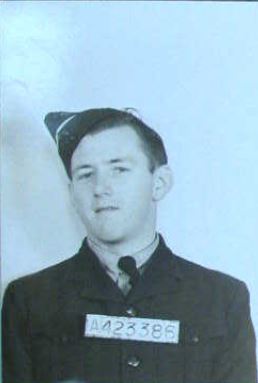 F/Sgt George Hilton Sansome 423386 RAAF, Bomb Aimer |
|
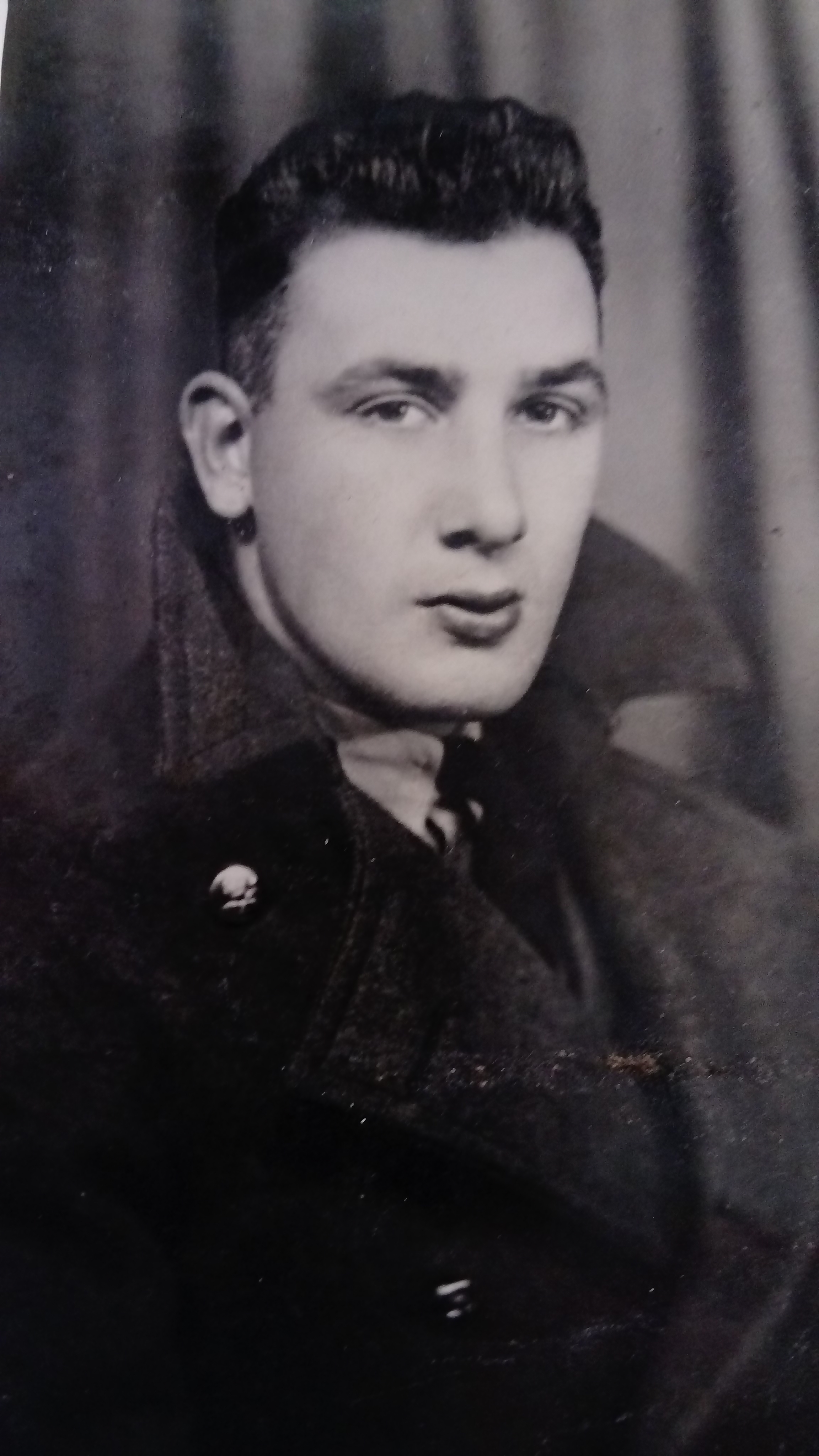 Sgt Leslie Harold Wildman 1158064, Wireless Operator/Air Gunner
|
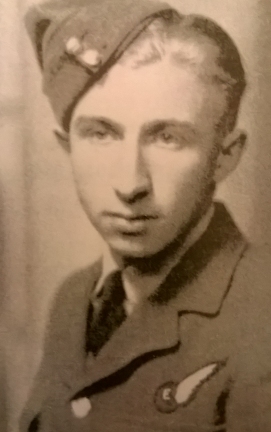 Sgt Edgar William Camp 1605423, Flight Engineer |
|
All images courtesy of Anne Tierney, the Wildman family
and the Australian National Archives. |
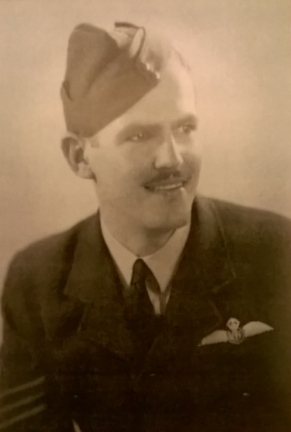 F/Sgt
Allan Stewart Johnston 409125 RAAF, Pilot
F/Sgt
Allan Stewart Johnston 409125 RAAF, Pilot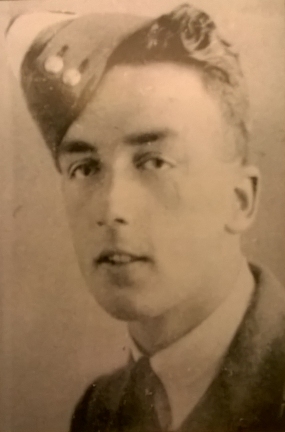 Sgt Robert
Mair Clark 1051117, Navigator
Sgt Robert
Mair Clark 1051117, Navigator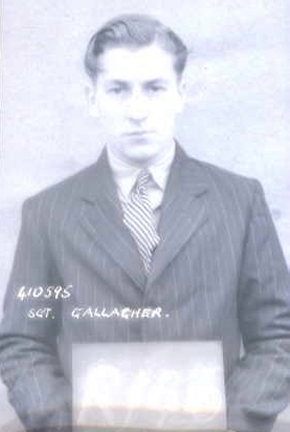 Sgt
Anthony Joseph Gallagher 410595 RAAF, Wireless
Operator/Air Gunner
Sgt
Anthony Joseph Gallagher 410595 RAAF, Wireless
Operator/Air Gunner 
Below are some photos taken during the unveiling in 2007, to give some idea of the touching ceremony laid on by the Lavally Community.
And so, the men of Halifax EB134 are remembered, as a crew, in the same way that they met their fate, together.
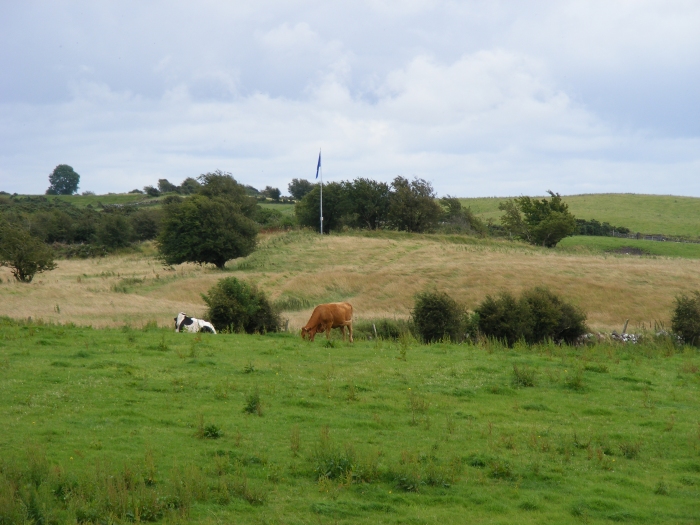
The crash location, marked for the day of the commemoration with
a flag.
One can review the casualty and service files for the three
Australian airmen above at the Australian national Archives
website, Recordsearch facility. Simply click on the link, go to
the Recordsearch link on the left hand side of the screen, chose
search method and then enter the 6 digit service numbers shown
above. (Instructions as per August 2007)
Australian National Archives
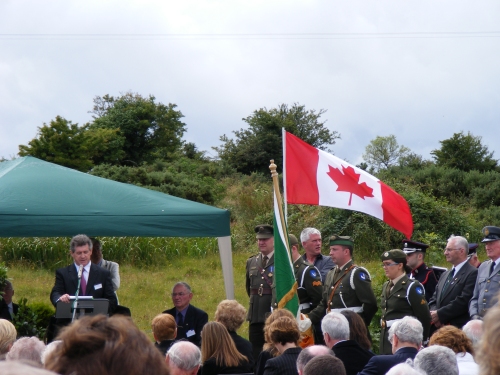 Tony McHugh, Lavally, introduces the EB134 Ceremony |
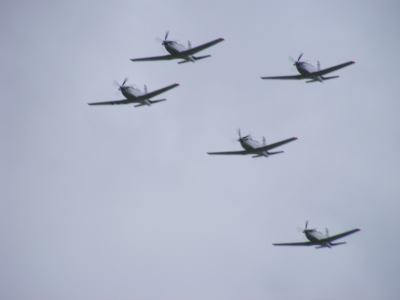 The five ship fly past of Irish Air Corps Pilatus PC-9 trainers. |
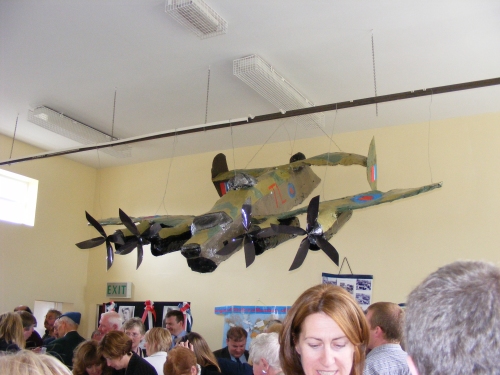 Part of the superb efforts carried out by Anne and Pat, Lavally National School children prepared a model of the ill-fated aircraft, along with the many wall mounted displays. |
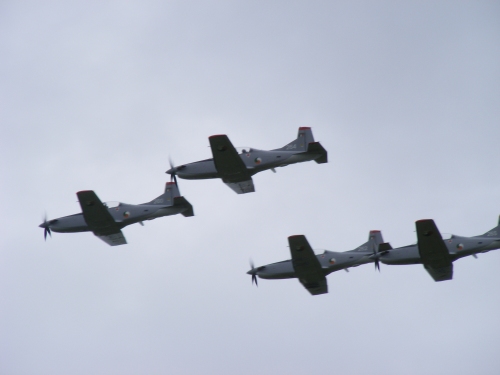 A final fly past by four of the aircraft. |
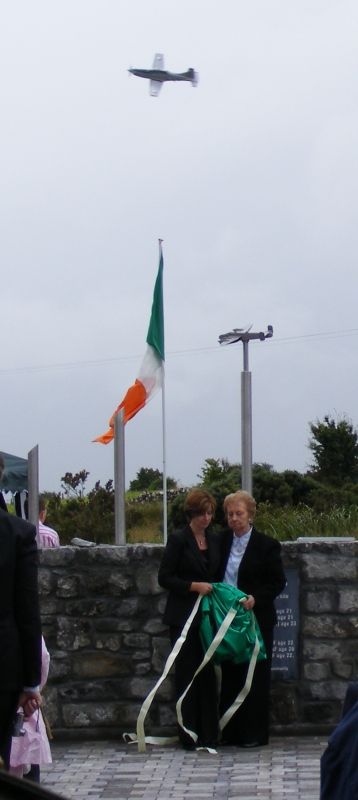 Following the unveiling of the memorial by Dorothy Clarke, sister of Robert M. Clarke, and her daughter, the last remaining aircraft passes the memorial. The monument's representation of EB134 points stationary to the crash site, a few fields away. |
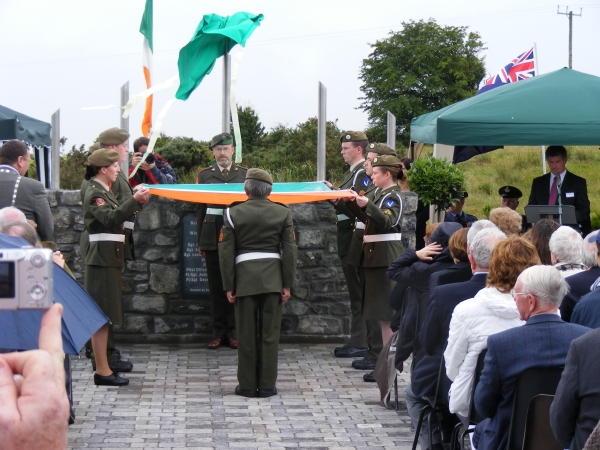 The tricolour is removed by members of the Irish Army 54th Field Artillery Regiment. |
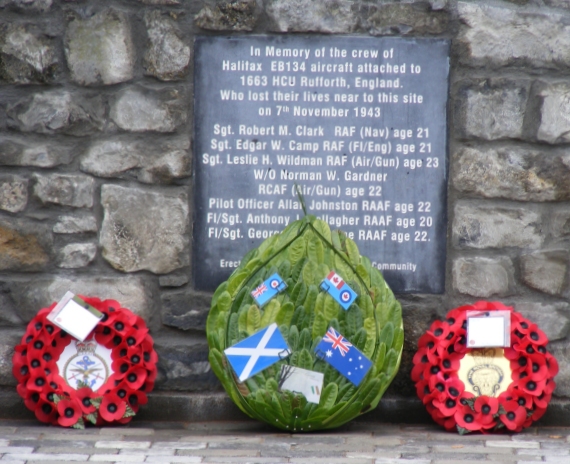 Wreathes laid at the memorial by the veterans associations. |
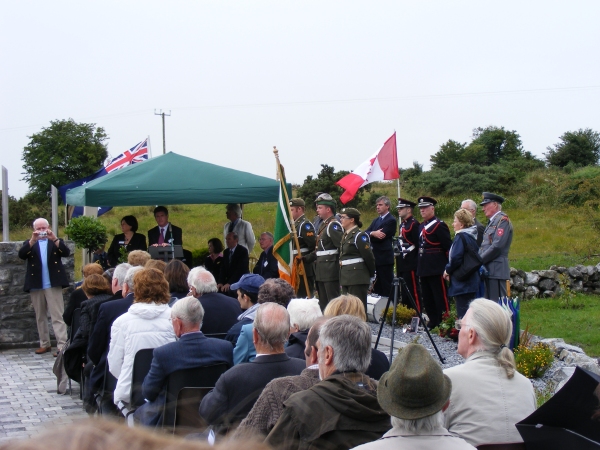 Tony McHugh and Anne Tierney watched on by the colour parties of the Irish Army and the Royal Air Forces Association. |
With special thanks to Anne Tierney, for researching this incident and for, along with the people of Lavally, taking these strangers into your hearts after all these years and giving them a fitting remembrance.
Compiled by Dennis Burke, 2020