
Vickers Wellington, Donegal, April, 1941
Good Friday, April 11th, 1941, would witness the crash of a
Royal Air Force anti submarine patrol aircraft on a rain soaked
Donegal hill side. The crash site was nearby to the Irish
Army coastal defence fort at Fort Lenan on Lough Swilly.
Weather on the day was very poor, but irish Army personnel at
both Forts Lenan and Dunree reported hearing noises in the
mountains thought to be an aircraft crash.
The Irish Army G2 branch intelligence officer for Western
Command Lieutenant J Birthistle, filed the following report on
the 14th of April , threes days after the crash and gives a
detailed description of the conditions the Irish Army found on
the mountain.
I have the honour to submit the
following report on the British Wellington Bomber which
crashed on the Urrws Hills between 15.02 and 15.15 hrs. on
April 11th, between Fort Dunree and Lenan.
I left Athlone at 20.00 hrs on 11th April, 1941, and arrived
at Fort Dunree at 08.30 hrs. on the 12th April, 1941.
There were various rumours in the Fort that a Second
Plane had crashed within 50 yards of the first, and
that the Nationality of the second plane was
German. Commdt. D. Farrell O/C. C.D.A.
informed me that British Officers had come over to the
Fort the previous evening in connexion with the crash, and
they asked his permission to visit the scene of the
crash the following day, and that he had granted
permission.
About 09.15 hrs. on the 12th April, 1941, the British Officers
arrived back at the Fort - a Naval Commodore Whitbourne
in charge of all craft in the Foyle, Lt. Roberts - Browne,
R.A.F., and Lt. Robertson, R.A.F., At 09.30 I left with
the three British Officers, 26 men and a Sergeant who
was at the plane the previous night and was acting as a
guide. We started to climb the mountain about
half-a-mile N.N.E. of Dunree. After an hour's climb
we were enveloped in a thick fog and mist,
and visibility was about 5 to 10 yards. We had the
greatest difficulty in keeping our party together, and I
instructed the leading man to let off a round every few
minutes to guide. After two hours,
it was apparent we were lost on the mountain; with the fog
it was impossible to take a bearing from any
point. Owing to extreme danger and difficulty
of traveling we got into single file. We wandered
through the mountain trying to get
back to Dunree. At about 13.00 hrs. by
pure accident, we came on the scene of the crash. It would appear
that where the plane struck the mountain one of the depth charges
exploded: the engines and the front of the plane
were blown about 60 yards up the mountain, while the body
and tail were blown down the mountain. The fact that
the plane was in two bits separated by
a clear 100 yards gave rise to the rumour that there
were two planes. The crew consisted of six men. Four
bodies were blown from the plane, and two had fouled the
wreckage and were completely burned. From the multiple
injuries on the bodies death must have been immediate.
The armament of the plane was three depth-charges; four
Browning Guns; (which are now in Dunree); and one
Vicker's Gun. One depth charge had exploded at
the crash; another seemed to have burnt out, while
the container of the third depth charge had
merely cracked open. It contained T.N.T. which was lying round.
The
British Officer explained that the detonator was still
attached to the container.
The following report was sent on 21st April from the O/C
Coastal Artillery, in Western Command.
British Wellington Bomber Crash - 11th
April, 1941.
With reference to our phone conversation today I wish
to submit the following report in reference to the above.
On Good Friday, 11th inst., accompanied by
Superintendent Garda, Buncrana, and Captain R.
Cooney, Fort Dunree, I paid my usual visit to
Fort Lenan at about 16.00 hours when Captain Joseph
Murray, O/C., Fort Lenan, informed me that he was of opinion
that an aeroplane had crashed at about 15.30 hours, on the
Urris Hills which is about three miles from Fort
Lenan. Captain Murray further stated that he
had sent out a party to make a search of the hills.
At about 19.00 hours I received a phone message
from Lieutenant Gallanagh, Orderly Officer, Fort Dunree,
to the effect that Sergeant Kemmy, Fort Lenan Detachment had
reported to Dunree and Kemmy stated that he located the crashed
plane on the Urris hills. I instructed
the Orderly officer Fort Dunree, to keep
Sergeant Kemmy there until I returned and I reached
Fort Dunree at about 19.45 hours. Sergeant Kemmy
told me that his party located the plane which was burning
and could not be approached.
Sergeant Kemmy reported that four dead bodies were on the
mountain side widely scattered. Lieut.
KcGinley then handed me a cheque book (which
he had received from Kemmy) marked Lloyds Bank and a
Driver's License bearing the name John William Hobson
Bateman. . When questioned Kemmy stated that he found these
articles on the ground near the plane. The
conditions at this time were "shocking" and I
decided to withdraw the Lenan Party and leave
no Guard on the wreck as it was positively dangerous,
and besides the guard could not be supplied with any
meal
during the night. I detailed a party
in charge of C/Sgt. Kiely to accompany Sgt. Kemmy to
the scene of the crash so that they would be
familiar with the route. C/Sgt. Kiely, Sgt. Kemmy and party
detailed returned to Dunree at midnight on the 11th inst. and
stated that they could not locate the plane due to the conditions
obtaining. I then instructed Lieuts. Gallanagh and McGinley
to go to the scene at 06.00 hours. on the 12th inst. and
collect any books, papers or maps that might be strewn about
and bring them back to me. The Superintendent, Garda
Siochana was present when I issued these orders and
he (the Supt.) stated that the bodies were not to be
interfered with until his arrival.
At about 21.30 hours three Officers representing the
R.A.F. from Limavady, arrived at the main gate Fort
Dunree, and requested an interview with me. The
senior Officer introduced himself as Captain Keane
(or Caine) and he introduced the remaining two as Pilot
Officers from Limavady. Having satisfied
myself that they were genuine I took all the party
to the Mess and entertained them and also agreed to
facilitate them in every way.
They asked me about the crash and I gave
them all the information I had in my possession and also
produced the Lloyds Cheque Book and Driver's License as
received from Sgt. Kemmy. The senior Officer (Captain Keane) then
remarked to a tall, fair headed pilot "you will need
these" and then asked me if I had any objection to him
retaining the articles mentioned. I
replied "certainly not." He retained
the cheque book and handed me back the Driver's
License so as to assist in identification if
required. This cheque book was
handed over in the presence of Captain Cooney. Lieuts.
McGinley and Gallanagh, Supt. Garda, Buncrana and our
Chaplain, (Father Dolan) .
The party proceeded to the scene at 06.0 hours in
the morning of the 12th inst. and conditions were as bad as
on the 11th, April, 1941. The reports submitted by
Lieuts. Gallanagh and McGinley give details of what occurred
subsequently.
I hope this report gives all the information you
require.
If you require any further
data I shall only be too pleased to facilitate you in
every way.
(D.J. Farrell) A/commandant.
Officer Commanding coast Defences, W/command.
The crash had involved the six man crew of a
Vickers Wellington anti submarine patrol aircraft flying with
RAF 221 Squadron from the RAF base at Limavady in Northern
Ireland. On the day after the crash 221 Squadron filed the
following report with the Officer Commanding RAF Limavady.
1. Wellington W.5653 (aircraft letter
'Q'), F/O. Cattley and crew, was ordered to carry out an A/S
patrol from Limavady on the 11th April,. 1941. They took off
at 0555 hours and were due to return at 1455 hours.
2. At 1440 hours I went to the Regional Control Office
to see what method of approach the pilot was intending to
use, i.e. S.I. beacon or descent through cloud using his 'Q'
code, as the cloud base was then 1000 - 1200 ft. over the
aerodrome and. 8/900 ft. on the hills.
3. The pilot was using the Regional Control procedure
the details of which are shown in the R.C.O's report
attached.
4. I had full confidence in the pilots ability to
carry out this procedure as he had been carefully instructed
in the 'Q' code procedure by the R.C.O. on the ground, and
had completed a successful air practice. He had also
on the 10th April made a descent through cloud using the
S.I. beacon.
5. At this time the aircraft had at least 3
hours petrol left and no anxiety was felt for its safety.
6. After 1500 hours nothing was heard from the
aircraft until a message was received that a British
aircraft, type unknown, had crashed near Fort Dunree (55 12N
07 34W) in Eire.
7. With the Station Commander's permission I
sent two Officers in civilian clothes to this position to
identify the aircraft, and if possible, the crew. Their
report is attached.*
8. The R.C.O. carried out the normal overdue
aircraft procedure.
* The report mentioned in point 7 above was not part of the
AIR81 file.
The aircraft involved had been on daytime operation that had
taken off at 05.55 on the morning of the 11th April and
the crash happened at around 15.15 that afternoon. The
telegrams in the AIR81 file confirm that the aircraft was
carrying 3 x 450 Lbs depth charges.
When 221 Sqn went "operational" at Limavady in late March/early
April 1941 it was with the Mark VIII Wellington which differed
from the standard Mark I in a number of ways and most obviously,
by the fitting of Mk 11 ASV AI (radar) as well as additional
fuel tanks in the bomb bay to increase range for their
designated job of hunting German U-Boats in the Western
Approaches.
B Flight of 221 Squadron started operations from Limavady in
early April 1941 and during this time the code letter D was
allotted to Wellington W5674 but not W5753. A well known Vickers
Armstrong photograph proves it showing W5674 in standard Bomber
Command Camouflage in April 1941 sporting DF-D. There is also a
later shot of W5674 when 221 were based in Iceland, this time in
the new "Coastal" camouflage of grey over white showing the code
letter O (DF-O).
The Operational Record Book for 221 Sqn did not reveal which
letter W5653 carried but within the AIR81 file for the crash it
was revealed to be the letter Q.
This crash produced some oft repeated inaccuracies in published
sources and on social media. One commonly repeated is that
the crew mistook Lough Swilly for Lough Foyle, there is no proof
of this because the whole of the West coast was enveloped in low
cloud and fog and it is unlikely that the crew could seen any
ground. They had already passed over Limavady at ETA 14.32 after
a long nine hour anti submarine patrol but could see nothing and
radioed that they were going to try a second approach.
The crew of W5653 consisted of two pilots of officer rank,
Cattley and Montague, and four sergeants, Badman, Bateman, Neill
and Whalley, all wireless Operator/Air Gunners.
Cattley, Bateman, Neill and Whalley had formed part of the
initial roster of 21 Squadron when it was formed in November
1940.
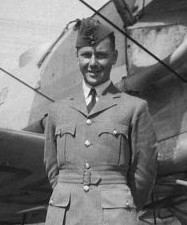 F/O
Alfred Patrick "Peter" CATTLEY 40888 +
F/O
Alfred Patrick "Peter" CATTLEY 40888 +
Alfred was the son of Nina and Patrick Cattley and was known as
Peter in the family. His father was a mining manager and
was himself born in Russia to English parents, and Alfred, in
turn was also born in Petrograd, Russia, his mother being
Russian. With the Russian revolution taking place, Alfred
and his two siblings left Russia with their parents and in 1920
moved to live in Harbin, Mancuria. After 1930, he had
returned to the UK to attend school and there after to take up
employment.
Alfred joined the RAF in 1937 on a Short Service Commission and
proceeded to complete his flying training with number 8 Flying
Training School. Upon graduation from training he was
posted to No. 1 Coastal Artillery Co-operation Unit before being
posted to 608 Squadron based at Thornaby on the 12th of March
1940 flying Avro Ansons and where he would become a crew
captain. In December 1940 he was posted to the then
forming 221 Squadron at Bircham Newton. His second
operational mission was an attack on ground targets in Holland
on the 4th of March 1941. The 13th of March seen a similar
mission being flown, during which he attacked a small vessel off
the Dutch coast. Upon return however he was forced to
force land the aircraft, Wellington N2834, as his
starboard engine had lost oil, seized and shed its
propeller. On the 29th of March he took a crew to Limavady
from Bircham Newton. He is recorded flying one patrol
mission on the 6th of April 1941 on W5353, and not again until
the fateful flight on the 11th.
His NCO crew members spent the best part of 12 months training
before going on Ops. This crew was the second in the Squadron to
be lost but the first whilst operating from Limavady. At the
time of his death, he had 902 hours operational flying time.
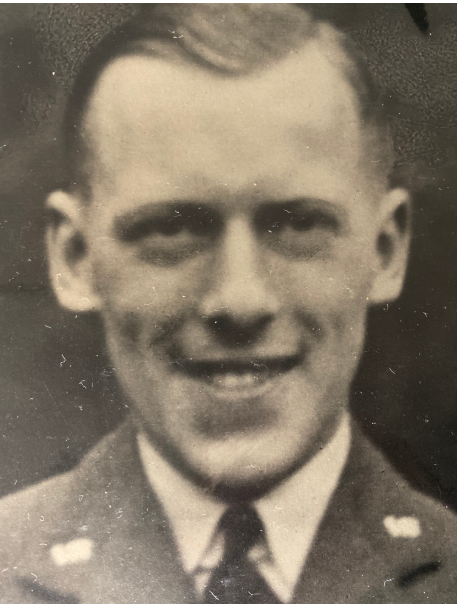 P/O
James Leonard MONTAGUE 81359 +
P/O
James Leonard MONTAGUE 81359 +
James was born in the summer of 1913 in Chalport,
Buckinghamshire to Edith Jane and Joseph Gibbard Mountague.
James enlisted in the RAF Volunteer Reserve as a pilot trainee
in November 1938. His service prior to receiving his
commission in June 1940 is not fully recorded on his officers
service record but he is listed on the September 1939 Register
at his parents address at Mathurst, Beaconfield. His
occupation is recorded as a Bank Clerk but he is also annotated
in the margin as a "Sergt, RAFVR 742621".
It is understood that he did not serve before the war except for
training but was mobilised upon declaration of war.
He had undertaken training from June 1940 at No. 2 School of
General Reconnaissance, posting from there in September 1940 to
500 Squadron for three months. His name doesn't appear to
be mentioned in the operational missions for that Squadron
during the period.
During this time, in the latter part of 1940, he was married to Peggy W Brown, herself also a bank clerk. Their time together would be tragically short.
His service records final movement seen him posted into 221
Squadron near the end of January 1941 along with 23 other
aircrew members from 500 Squadron. At this time, the squadron
diary only lists the captains of aircraft so James' missions are
not recorded. He did however Captain one patrol on 19th of
March 1941.
The Bucks Free Press published a funeral notice on the 18th of
April:
Pilot-Bomber J. Montague, R.A:F., who
lost his life somewhere in Ireland, was a son of Mr. J. G.
Montague, of " Mathurst," Woodside Avenue, Beaconsfield, and
for some years hon. secretary of the Beaconsfield Cricket
Club. The young airman, who was married, was a keen
cricketer, and rendered good service to the Beaconsfield
club. His funeral takes place at Beaconsfield on Saturday.
His funeral was held on Saturday, 19th of April, 1941 at the
parish Church of Engfield Green. His remains were borne by
six RAF airmen and the service was attended by members of the
Beaconsfield Cricket Club.
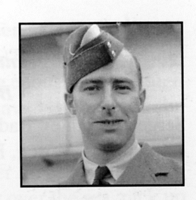 Sgt John
William Hobson BATEMAN 959540 +
Sgt John
William Hobson BATEMAN 959540 +
He was listed on the strength of the Squadron on the 31st of December 1940.
The Lincolnshire Echo published the following death notice on
the 19th of April 1941.
Mr. and Mrs. Hobson Bateman, of
Limehurst, Sutton Bridge, have been notified of the death of
their second son, Sergeant Jack Bateman, R.A.F.V.R., who has
been killed on active service. Sergeant Bateman, who was 28,
joined the R.A.F. a year ago, and was an observer. He had
taken part in many raids over enemy territory.
Before joining up he was a bulbgrower and nurseryman at
Sutton Bridge.
Sergeant Bateman took a great interest in sport and
played for the Sutton Bridge Cricket Club. He was unmarried.
An Altar and Reredos is dedicated in memory of Hobson Bateman,
died 1942, Amelia Elizabeth, his wife who died in 1956 and their
son Jack Bateman. It was erected by James R Bateman and
Roy (Raymond) Bateman, surviving brothers of Jack in 1957 after
their mothers death. Jack's father, Hobson, died one year
after his son, almost to the day in April 1942.
Sgt Bateman's remains were returned to his parents and buried
in Saint Matthews Churchyard, Sutton Bridge.
Sgt Francis Kenneth Basil WHALLEY 977309 +
Francis was the son of Charles Harold and Agnes Blanche Whalley,
of Leamington Spa.
Francis joined the colors in January 1940 and passed through
training at No. 8 Bombing and Gunnery School from February 1940,
No. 1 Electrical and Wireless school from may 1940, finishing up
at 10 B&GS from where he posted out to 221 Squadron at the
end of November although his name does not appear on the roster
of 31st December 1940.
The Coventry Evening Telegraph published a short funeral notice
on April 19th:
The funeral took place at Leamington
Cemetery yesterday cf Sergeant Air Gunner Francis Kenneth
Basil Whalley, of the R.A.F., 19-years-old son of Mr. and
Mrs. C. H. Whalley of 18. Victoria Terrace,
Leamington. Sergeant Whalley was killed on active
service.
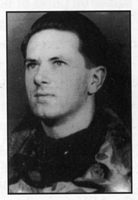 Sgt
Frederick George NEILL 976110 +
Sgt
Frederick George NEILL 976110 +
He was listed on the strength of the Squadron on the 31st of
December 1940.
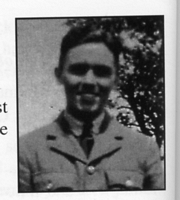 Sgt
Brinley Francis BADMAN 976192 +
Sgt
Brinley Francis BADMAN 976192 +
Son of Gertrude and James Badman, Brinley was born in 1919
in Abersychan, Wales.
He was listed on the strength of the Squadron on the 31st of
December 1940.
The South Wales Argus published his death notice on the 21st of
April 1941 with the same small image as shown on this page.
DIED ON ACTIVE SERVICE
Sergeant Brinley Francis Badman, R.A.F. son of Mr. and
Mrs. J. A. Badman, 21. Cross-row, Varteg. Intimation
has been received that he died while on active service
against the enemy.
An earlier message indicated that he was "missing,
believed killed."'
Sergeant Badman was an old boy of West Monmouth School.
Before he joined the R.A.F he was a colliery
weighman. He was 21 last May, and for many years was
closely identified with Varteg Wesleyan Methodist Church He
was Secretary of the Young People's Guild, a member of
the Church choir, and an assistant organist of the Church.
In the R.A.F. he was acting wireless operator and air
gunner, and had operated over German territory.
He was home on leave three weeks ago.
A brother, Cliff Badman, formerly of West Monmouth
School, is now at Exeter University.
Over the years, many efforts were made to memorial the crash
site.
A memorial ceremony was held near the crash site in 2019 ?, with
a gathering of up to 250 people. A cross made from some of
the aircraft metal was made into a cross and placed at the crash
site.
As of 2019 at least there is was one cross made from tubular
parts of the aircraft and at its base a plaque containing the
mens names. Another cross is made possibly from wood
and bearing a smaller metal plate. These are set among a
collection of parts remaining from W5653, including one landing
gear leg and an engine cowling exhaust ring.
The following website provides a digital path to the crash site
and local mountain area.
Compiled by Dennis Burke, 2025.